Wild Fortune Payment Methods Australia: Deposits, Crypto and Cashier Guide
 Available in US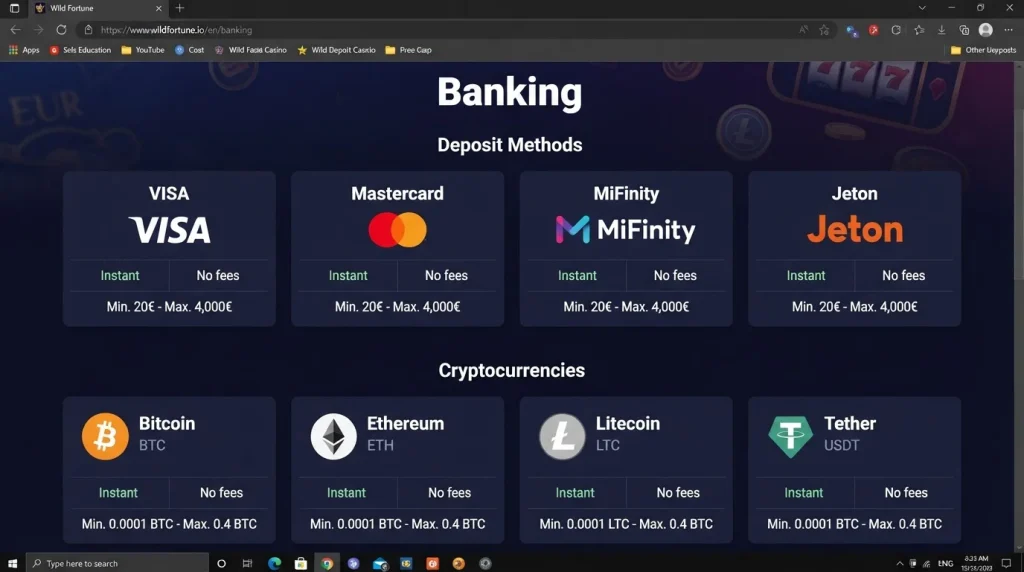
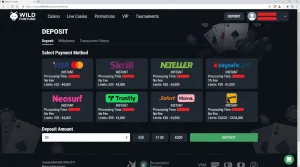
Wild Fortune supports AUD-facing play, card payments, alternative payment methods and a broad set of cryptocurrencies, but the exact cashier menu can vary by account and location. For an Australian reader, the useful distinction is between methods the operator documents publicly and methods that are actually offered after login. Wild Fortune’s terms support Visa, Mastercard and alternative payment methods, while its banking page lists crypto deposits including BTC, ETH, LTC, DOGE, USDT, XRP, ADA, TRX and BNB. The AU-facing site presents values in Australian dollars. PayID, however, should not be treated as a confirmed current Wild Fortune option unless it appears in the live cashier. This page explains what is listed, what is dynamic, and where deposits differ from withdrawals.
Table of Contents
- What is listed about Wild Fortune payment methods
- AUD presentation does not mean every rail is Australia-specific
- Cards: what Visa and Mastercard support actually tells you
- Crypto support is broad, but transaction details are dynamic
- PayID: a search signal, not a confirmed current cashier method
- Withdrawal rules that affect payment choice
- Fees: separate casino charges from provider costs
- How to check the cashier before committing funds
- Which Wild Fortune payment method is the best fit?
- Questions about Wild Fortune payment methods
What is listed about Wild Fortune payment methods
Wild Fortune’s terms and banking pages list the supported payment categories. Those sources confirm support for common card rails and alternative methods, and they list multiple cryptocurrency options. They do not establish that every payment rail shown globally will appear for every Australian account at every moment. Payment processors can be enabled or disabled by jurisdiction, account status, transaction direction and provider rules.
| Payment family | Typical use | What is listed | What still needs a live check |
|---|---|---|---|
| Visa and Mastercard | Deposits and supported card withdrawals | Official terms name both card networks. | Whether a particular Australian-issued card is accepted, plus the limits shown to that account. |
| Alternative payment methods | Mainly deposits, sometimes withdrawals | Official terms confirm alternative methods are supported. | The exact provider names available in the AU cashier. |
| Bank-transfer variants | Deposits and withdrawals where enabled | The official banking environment includes bank-transfer style rails. | The specific Australian rail and whether it supports both directions. |
| Cryptocurrency | Deposits and crypto-based transactions where enabled | BTC, ETH, LTC, DOGE, USDT, XRP, ADA, TRX and BNB are listed on the official banking page. | The asset list, network, address format, minimum and limits displayed at transaction time. |
| PayID | Australian bank payment rail | It appears in Australian search discussion, but it is not currently confirmed as a live Wild Fortune AU method. | Whether PayID is actually visible after login for the specific account. |
AUD presentation does not mean every rail is Australia-specific
Wild Fortune’s Australian pages display AUD and AU$ values, which is useful because bonus figures and some limits can be read without mentally translating from another fiat currency. That localization should not be confused with a fixed Australian payments catalogue. A site can show AUD while relying on a mix of international card processors, bank-transfer providers, e-wallet style alternatives and crypto gateways. The real decision point is the cashier after login.
This is why a payment method should be checked in three dimensions: whether it is offered at all, whether it supports the intended direction, and what limits or fees are displayed for the individual transaction. A method shown for deposit is not automatically available for withdrawal. Likewise, a card accepted for funding can still have different payout support because card withdrawals use separate transfer capabilities and issuer rules.
For a practical account setup sequence, the registration guide explains where cashier access fits into account creation. If the main objective is simply to fund the account, the deposit methods guide keeps the focus on the deposit side rather than mixing in cashout rules.
Cards: what Visa and Mastercard support actually tells you
Wild Fortune’s terms explicitly reference Visa and Mastercard. That establishes card support as a payment family, but it does not guarantee that every Australian bank will approve a gambling-related transaction. Issuing banks can apply their own merchant-category controls, risk checks and transaction restrictions. A card can therefore be technically supported by the casino and still be declined by the issuer.
Card users should also distinguish funding from payout capability. The current terms describe Original Credit Transfer for Visa and Payment Transfer for Mastercard withdrawals, subject to supported-country and issuer conditions. If a card payout is unavailable, the terms allow a different payout route to be used. That is one reason it is sensible to check withdrawal compatibility before making a large first deposit rather than assuming the funding rail will also be the preferred cashout rail.
Crypto support is broad, but transaction details are dynamic
The official banking page lists a substantial crypto set: Bitcoin, Ethereum, Litecoin, Dogecoin, Tether, XRP, Cardano, TRON and BNB are among the documented options. That is enough to establish that crypto is part of the banking mix. It does not justify treating one token, one network or one minimum as permanent. Crypto deposit thresholds and exchange-rate calculations can change, and the transaction screen is where the current network and amount should be checked.
Wild Fortune’s terms state that accepted fiat and cryptocurrency currencies include AUD alongside multiple crypto assets. They also state that crypto transactions use a real-time exchange rate mechanism and that the casino does not provide a general fiat-to-crypto conversion service inside the account. In practice, that means a user funding with crypto should verify the asset, network and destination address in the cashier and should check the current cashier because crypto limits can change.
Crypto also does not remove identity or withdrawal checks. Payment choice and verification are separate issues. The trust and licence page covers the broader operator and regulatory context, while the account verification page deals with KYC rather than treating cryptocurrency as a shortcut around account controls.
PayID: a search signal, not a confirmed current cashier method
PayID availability should be checked in the current cashier, as payment methods can vary by account and change over time.
The correct check is simple: log in, open the cashier, select Deposit, and inspect the available bank-payment options. If PayID is present there, the live account screen is the relevant information for that account. If it is absent, the public banking page should not be stretched to imply otherwise. The same logic applies to any local bank rail or e-wallet name that is not explicitly confirmed by current first-party information.
Withdrawal rules that affect payment choice
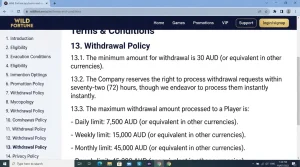
The withdrawal side has its own rules and should not be inferred from the deposit menu. Wild Fortune’s current terms list an AUD minimum withdrawal of AU$30. They also state that the operator aims to process withdrawal requests within 72 hours after approval, while actual payout timing depends on the method and verification status. These are operator-side terms, not a promise that funds will land in a bank account within exactly 72 hours.
The same terms list general Australian withdrawal frequency limits of AU$1,500 per day, AU$7,500 over a rolling seven-day period and AU$22,500 per month. Method-specific limits can still be lower and are shown during withdrawal. Large balances can therefore require multiple payments even when the account is otherwise approved. The withdrawal limits and timing guide explains those cashout rules in detail so they are not duplicated here.
Fees: separate casino charges from provider costs
The banking page labels a number of listed deposit methods as free, but that does not mean every transaction is costless from end to end. Banks, card issuers, crypto networks and intermediary institutions can impose their own charges. Foreign-exchange effects can also matter where a payment provider handles the transaction differently from the AUD balance shown by Wild Fortune.
For withdrawals, the terms explicitly warn that intermediary banks can impose fees on bank transfers and that payment providers can apply their own costs. This is another reason not to publish a blanket statement that all deposits or withdrawals are free. The operator’s displayed fee and the external provider’s fee are separate variables.
How to check the cashier before committing funds
- Confirm the account currency. The AU-facing experience uses AUD, but the transaction screen should still be checked before submitting a payment.
- Choose the direction first. Decide whether the method is needed only for a deposit or whether withdrawal compatibility matters too.
- Read the live limits. Minimum and maximum amounts can differ by method even when broader account limits are documented in the terms.
- Check provider fees. A casino-side fee of zero does not rule out issuer, intermediary-bank, network or conversion costs.
- Check bonus consequences. If a promotion is being claimed, confirm the relevant deposit threshold and opt-in conditions rather than assuming every successful deposit qualifies.
- Keep method ownership consistent. Use a payment instrument belonging to the account holder and be prepared for verification where required.
Which Wild Fortune payment method is the best fit?
There is no single best option for every Australian user because the answer depends on what the live cashier offers and what matters most: bank familiarity, card convenience, crypto access, payout compatibility or transaction cost. Cards are straightforward where the issuer accepts the transaction. Crypto provides a broad set of documented assets but adds network and exchange-rate considerations. Alternative and bank-transfer methods can be useful when they are actually enabled for the account.
Check the available payment methods in the logged-in cashier, as they can vary by account and location. That avoids two common mistakes: assuming a globally listed method must be available locally, and treating a search result such as PayID as proof of current support. For a broader assessment beyond banking, return to the full Wild Fortune Australia guide.
Questions about Wild Fortune payment methods
Does Wild Fortune support AUD?
Yes. Wild Fortune’s Australian-facing pages display AUD and AU$ values. The specific payment rail used to move those funds still depends on the cashier options available to the account.
Can Australians use Visa or Mastercard at Wild Fortune?
Wild Fortune’s terms support Visa and Mastercard as payment families. Acceptance of a particular Australian-issued card is still subject to the cashier, the issuing bank and transaction controls.
Does Wild Fortune accept cryptocurrency?
Yes. Its official banking materials list multiple assets, including BTC, ETH, LTC, DOGE, USDT, XRP, ADA, TRX and BNB. The transaction screen should be used to confirm the current network, minimum and limits.
Is PayID available at Wild Fortune?
PayID is not confirmed as a current Wild Fortune AU cashier method. Treat it as available only when it appears in the live cashier for the account.